
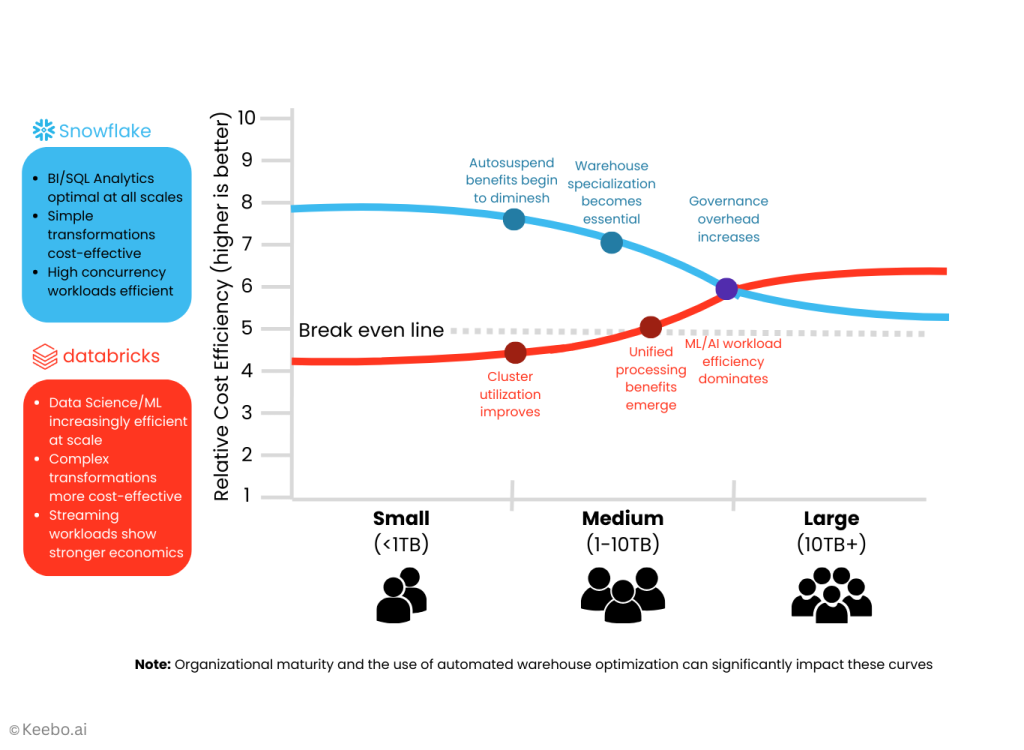
In the constantly evolving landscape of financial services, efficiency and precision are paramount. As companies handle vast amounts of data, the need for streamlining processes, especially in Financial Operations (FinOps), has never been greater. The integration of sophisticated platforms like Snowflake and Databricks is becoming increasingly essential for financial institutions aiming to optimize their data operations and control costs effectively. This guide explores how these platforms can be leveraged to enhance FinOps in the financial sector.
Understanding FinOps in Financial Services
Financial Operations, commonly known as FinOps, involves the management of cloud financial management and operational practices to ensure that organizations maximize the value of their cloud investments. For financial institutions, this means ensuring compliance, cost-efficiency, and security while managing complex datasets.
Key Challenges
- Managing data from multiple sources while maintaining data quality and consistency.
- Ensuring cloud data compliance for finance teams and adhering to regulatory standards.
- Optimizing cloud costs without compromising on data accessibility and performance.
- Maintaining robust security protocols to protect sensitive financial information.
The Role of Snowflake and Databricks
Both Snowflake and Databricks offer robust solutions that can address the challenges mentioned above. These platforms are designed to provide a secure, scalable, and efficient data stack tailored to the needs of financial services.
Snowflake: A Comprehensive FinOps Solution
Snowflake provides a cloud-based data platform that excels in handling structured and semi-structured data. Its architecture supports seamless data sharing and collaboration, making it an ideal choice for financial data optimization Snowflake. Key features include:
- Elastic scaling to manage increasing data loads efficiently.
- Advanced data sharing capabilities that ensure secure collaboration across teams.
- Robust data governance and Snowflake FinOps for banks to manage regulatory compliance.
Databricks: Enhancing Data Analytics
Databricks offers a unified analytics platform that simplifies big data processing and collaborative data science. For financial institutions, this means unlocking new insights with Databricks for banking analytics. Significant advantages include:
- Support for a wide range of programming languages and data formats.
- Scalable data processing capabilities to handle large-scale computations.
- Real-time analytics that provide actionable insights into financial data.
Streamlining FinOps with Integrated Solutions
Integrating Snowflake and Databricks into a financial institution’s data strategy can create a cost-efficient data stack for financial services. This integration allows for:
- Databricks usage tracking for FSIs to monitor and optimize resource allocation.
- Enhanced observability and traceability for audit-ready observability for finance.
- Secure and compliant data pipelines ensuring secure cloud analytics for financial firms.
- Reduction of operational overhead by automating routine tasks and processes.
Cost Management and Optimization
Effective cost management is crucial in the financial sector, where margins can be slim. Leveraging the capabilities of Snowflake and Databricks can help financial institutions reduce cloud data cost in banking by:
- Implementing cost monitoring tools to track and manage expenses.
- Optimizing resource allocation through predictive analytics and machine learning.
- Adopting a FinOps platform for investment data to ensure strategic financial planning.
In conclusion, the adoption of Snowflake and Databricks within financial services offers a strategic advantage in terms of efficiency, compliance, and cost management. By streamlining FinOps with these platforms, financial institutions can ensure they are not only meeting current demands but are also prepared for future challenges in the ever-evolving financial landscape.